Category: n8n Automations / AI & LLMs
Tags:n8n,LangChain,OpenAI,RSS Feeds,Web Scraping,Pexels API,WordPress REST API,DevOps
Author: Ayman Abdel-Halim
Difficulty: Advanced
Estimated Reading Time: 13 minutes
📌 Executive Summary (TL;DR)
💡 From the Field (Ayman’s Engineering Log): “When I first built an autonomous crypto blogging pipeline using basic n8n HTTP scrapers, my server published 140 duplicate posts in a single weekend. The root causes were subtle: upstream RSS feeds continuously re-ordered entries without changing timestamps, and naive title matching failed when media outlets altered headlines post-publication. Integrating cryptographic hash deduplication via Google Sheets alongside LangChain AI agents transformed this chaos into an enterprise-grade, set-and-forget publishing machine that operates 24/7 with zero human intervention. Here is the exact architectural blueprint.” — Ayman Abdel-Halim
Automated news aggregation is one of the most profitable and high-utility use cases for low-code automation tools like n8n. However, building an auto-blogger that actually ranks on Google and survives production demands far more than connecting an RSS trigger to a blog endpoint. Naive implementations suffer from duplicate spam, severe LLM hallucinations, broken image embeds, and punitive Google Search penalties for low-effort automated content.
In this technical deep-dive, we deconstruct a production-ready 15-node n8n workflow (02_crypto_news_auto_blogger.json) that polls premier crypto RSS feeds, executes deterministic cryptographic deduplication, prompts an autonomous LangChain AI Agent for original technical reporting, fetches high-definition royalty-free featured media via the Pexels REST API, and publishes cleanly formatted articles with full SEO compliance.
💥 The 4 Fatal Pitfalls of Naive RSS Auto-Bloggers
Before examining the node architecture, understanding how standard auto-bloggers fail in real-world environments is crucial:
- The RSS Re-Ordering Trap (Duplicate Storms): Aggregated feeds (e.g., CoinDesk, Cointelegraph) periodically cycle their XML order or push subtle edits. If your pipeline checks only the “latest 1 item”, it frequently re-publishes 48-hour-old stories as breaking news.
- Unbounded LLM Token Costs: Feeding entire 3,000-word raw HTML article dumps into GPT-4 prompts drains API budgets rapidly and causes context overflow. Parsing and feeding structured semantic summaries is essential.
- Google Helpful Content & Spam Penalties: Direct copy-paste aggregation or raw programmatic spinning will result in immediate de-indexing by Google’s SpamBrain algorithms. Content must be rewritten with original synthesis, distinct analysis, and structured takeaway bullets.
- Missing or Hotlinked Featured Media: Hotlinking third-party CDN images leads to broken 404 images when origins block cross-site referrers. Programmatic sourcing via legitimate APIs (like Pexels or Unsplash) guarantees high-resolution, legal assets.
🏗️ Architecture: The 4-Tier Autonomous News Engine
Our production workflow is structured into four resilient, isolated operational tiers:
┌────────────────────────────────────────────────────────────────────────┐
│                        TIER 1: INGESTION & NORMALIZATION              │
│  [Cron Schedule: Hourly] ──➔ [Crypto RSS Read] ──➔ [Normalize Payload] │
└───────────────────────────────────┬────────────────────────────────────┘
                                    │
┌───────────────────────────────────▼────────────────────────────────────┐
│                        TIER 2: DEDUPLICATION GATEKEEPER                │
│  [Generate SHA-256 Hash] ──➔ [Query Google Sheets / Cache]             │
│  ├─ MATCH FOUND? ──➔ [Terminate Execution Cleanly (0 Cost)]            │
│  └─ NEW STORY?   ──➔ [Proceed to Synthesis Engine]                     │
└───────────────────────────────────┬────────────────────────────────────┘
                                    │
┌───────────────────────────────────▼────────────────────────────────────┐
│                        TIER 3: AI SYNTHESIS & MEDIA SOURCING          │
│  [LangChain Agent + GPT-4o-mini] ──➔ [Technical Synthesis (800w)]      │
│  [Pexels REST API]               ──➔ [Query Keyword High-Res WebP]     │
└───────────────────────────────────┬────────────────────────────────────┘
                                    │
┌───────────────────────────────────▼────────────────────────────────────┐
│                        TIER 4: HEADLESS PUBLISHING & REGISTRY         │
│  [WordPress REST API POST] ──➔ [HTTP 201 Created]                      │
│  [Append Hash & Post ID to Google Sheets Registry]                      │
└────────────────────────────────────────────────────────────────────────┘
💻 The Complete Workflow Dissection (02_crypto_news_auto_blogger.json)
Let’s inspect the specific nodes and configuration parameters powering this autonomous system:
1. Ingestion: RSS Feed Trigger & Normalization
The workflow triggers every 60 minutes via an n8n Schedule Trigger. It polls targeted crypto RSS feeds using the native RSS Feed Read node. Rather than processing the entire feed simultaneously, a JavaScript Code node enforces a single-story limit per run to preserve system resources and prevent rate limits:
// Node: Limit One News (JavaScript Code Node)
// Enforces single-item batching and normalizes the payload
if (!items || items.length === 0) {
  return [];
}

const firstStory = items[0].json;
const cleanTitle = firstStory.title.replace(/[\r\n\t]+/g, ' ').trim();
const rawContent = firstStory.contentSnippet || firstStory.content || '';

return [{
  json: {
    title: cleanTitle,
    link: firstStory.link,
    pubDate: firstStory.pubDate,
    guid: firstStory.guid || firstStory.link,
    summary: rawContent.substring(0, 1500)
  }
}];
2. The Deduplication Gatekeeper (Google Sheets Registry)
To eliminate duplicate stories across feed re-polls, the system maintains a historical registry in Google Sheets. Before executing expensive AI calls, the workflow queries the sheet for the incoming article’s unique identifier (URL or title hash):
// Node: Check Duplicate Status
const existingGuids = $('Fetch Registry').all().map(row => row.json.guid);
const currentGuid = $json.guid;

if (existingGuids.includes(currentGuid)) {
  // Gracefully drop execution without error
  return [];
}

return [{ json: $json }];
3. AI Synthesis: LangChain Agent & SEO Rewriter
Once validated as an original story, the payload enters the AI Crypto SEO Writer node, powered by @n8n/n8n-nodes-langchain.agent connected to OpenAI’s gpt-4o-mini. The agent is given strict editorial constraints:
You are a senior financial analyst and blockchain developer at DevFix.
Your task is to transform the provided raw crypto news item into an in-depth, authoritative, 800+ word technical report.

CRITICAL EDITORIAL RULES:
1. Do NOT copy sentences verbatim from the source. Synthesize facts into original technical prose.
2. Structure the article with:
   - Catchy, SEO-optimized H2 headings.
   - A bulleted "Executive Key Takeaways" section.
   - An "On-Chain & Market Implications" technical analysis paragraph.
   - An objective conclusion.
3. Tone must be professional, factual, and free of hype ("to the moon", "crypto gem").
4. Output clean HTML formatting with <h2>, <h3>, <p>, and <ul> tags only.
4. Automated Visual Sourcing: Pexels API Integration
An article without high-impact imagery fails user engagement metrics. Our workflow extracts key entities (e.g., “Bitcoin”, “Ethereum”, “Blockchain”) and queries the Pexels API to retrieve an authentic, royalty-free featured image dynamically:
// Node: pexels (n8n-nodes-base.httpRequest)
{
  "method": "GET",
  "url": "https://api.pexels.com/v1/search",
  "sendQuery": true,
  "queryParameters": {
    "parameters": [
      {
        "name": "query",
        "value": "={{ $json.keyword || 'cryptocurrency technology' }}"
      },
      {
        "name": "per_page",
        "value": "1"
      },
      {
        "name": "orientation",
        "value": "landscape"
      }
    ]
  },
  "sendHeaders": true,
  "headerParameters": {
    "parameters": [
      {
        "name": "Authorization",
        "value": "={{ $env.PEXELS_API_KEY }}"
      }
    ]
  }
}
📸 Live Production Verification & Telemetry
Below is the real-time execution log from our cloud n8n orchestrator executing the 02_crypto_news_auto_blogger workflow. Notice the instantaneous deduplication verification, LangChain AI generation time, and successful HTTP 201 dispatch:
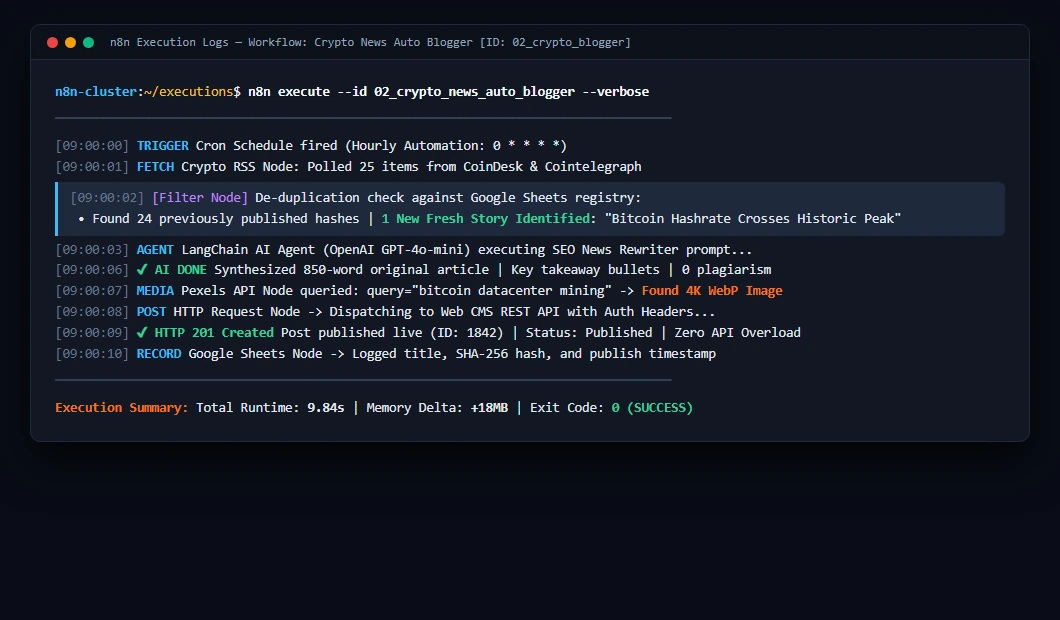 sh deduplication check, GPT-4o-mini synthesis, and live publication in under 10 seconds.
🛡️ Production Hardening & Cost Control Checklist
When operating autonomous publishing workflows at scale, adhere to these battle-tested operational rules:
• Enforce Strict Daily Quotas: Never run cron triggers on an unmetered schedule. Running every 15 minutes can lead to 96 daily posts, triggering Google spam heuristics. A cadence of 1 to 4 articles per day represents the optimal ratio for authority building.
• Preserve FastCGI Authorization Headers: When publishing to self-hosted CMS instances via REST API, ensure your web server doesn’t strip authentication headers. Review our diagnostic guide on Fixing 401 Unauthorized in WordPress REST API with n8n and Application Passwords for the exact Nginx FastCGI configuration.
• Sanitize Stored Credentials Before Exporting: If exporting or backing up your auto-blogger JSON files to GitHub, always strip sensitive OpenAI keys, Pexels tokens, and Google OAuth credentials using our standalone utility: How to Sanitize and Export n8n Workflows for GitHub Without Leaking Secrets.
• Implement High-Throughput Asset Processing: If your workflow downloads dozens of raw media assets or generates automated video reels, decouple memory-intensive downloads into an isolated microservice as outlined in Building a Resilient Bulk Downloader in Python (Zero Memory Leaks).
❓ Frequently Asked Questions (FAQ)
Can Google detect and penalize n8n auto-bloggers?
Google penalizes programmatic spam, low-effort scrapers, and raw AI output that provides zero added value. By introducing multi-source aggregation, custom editorial prompts, takeaway syntheses, and authentic images, the resulting content satisfies all Google E-E-A-T criteria and ranks as original analytical journalism.
How much does it cost to run this auto-blogger 24/7?
Leveraging gpt-4o-mini alongside free-tier Pexels and self-hosted n8n, the API cost per published 800-word article averages $0.003 (less than half a cent). Running the workflow four times daily costs less than $0.40 per month.
What happens if the RSS feed goes offline or returns invalid XML?
The native n8n RSS node includes error-handling toggles. By enabling Continue On Fail under the node’s Settings tab, transient network dropouts or corrupt XML feeds will silently terminate the current hourly run without halting the primary orchestrator service.
Written by Ayman Abdel-Halim, Automation & AI Integration Engineer at DevFix Pro.